

Another planning success - 80MW battery project in Saltash, Cornwall
Infrabee's plans for a Battery Energy Storage Facility in Saltash, Cornwall have been approved!
The BESS facility, which is to be located on 3.62ha of land at Landulph, Saltash, Cornwall, has been designed with an electrical output of 80MW of energy.
The development includes for substantial habitat improvements, including new areas of scrub and meadow grassland outside of the BESS compound. The addition of substantial areas of woodland and hedgerows will result in an impressive 1,193% biodiversity net gain in hedgerow units.
As well as playing an essential part in the UK's transition to net zero through addressing the mismatch in renewable energy supply and demand, the scheme will also create jobs, provide a diversified income stream to local farm businesses and generate business rates for investment in council services.
Infraland were assisted on the scheme by Lanpro Services who provided expert planning, landscape, heritage and ecology advice.
Infrabee's Director of Planning, Hannah Salmon said "We are thrilled to have secured full planning permission for our BESS site under officer delegated powers. We are immensely proud of this scheme and have worked hard from the site identification stage, to successfully integrate the development into its surrounding landscape, minimise ecological impacts and maximise biodiversity gain."

A Busy 2024 for Infraland's Solar Farms
As 2024 comes to a close we can look back upon a busy and successful year for Infraland in what has been a turbulent energy market! Of our 21 solar PV sites under development, we have seen planning consents come through for a number of projects including:
60 MWp at Oakley near Loughborough
10 MWp with 8 MW battery storage at Burton Top near Harrogate
15 MWp at New Milton in Hampshire
22 MWp at Rowley Hill near Haverhill in Essex
A further 40MWp at Wickham Hall near Bishop Stortford
We were also successful in obtaining Contract for Difference (CfD) contracts for our projects at Chestnut Farm (23 MWp), Highfields Farm, Costock (66 MWp) and Burton Top which were our first entries into the scheme.
Our Chestnut Farm project started construction in September following successful project financing with Novuna and Ethical Power acting as EPC contractor. Hall Farm is also under construction after an investment by Ampyr Solar Europe.
Our team is very proud to be moving forward with these projects in collaboration with investors, and we look forward to more progress in 2025.

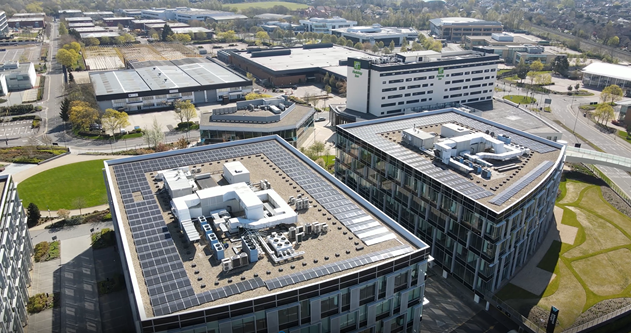
Infraland delivers another 152kW of rooftop solar PV at Chineham Business Park
Infraland, working as Employer’s Agent for Frasers Property UK, is thrilled to have brought a further 152kW of rooftop solar PV to Chineham Business Park, Basingstoke (https://www.chinehampark.co.uk/). The total rooftop solar installed at the Park now stands at 712kW which is a fantastic achievement for Frasers. The latest project installed 152kW across two building roofs is fully commissioned and operational. Infraland has been involved in the project from the outset providing financial modelling, managing the grid connection, tendering of the construction contract and then overseeing the commissioning sign off of the installation. The project was delivered on time and on budget with Ivegate Limited working as the main contractor. For Frasers Property UK, this is another rooftop solar PV project that demonstrates their commitment to achieve net zero carbon in all landlord controlled areas by 2030.
Infraland delivers 560kW Rooftop Solar Project
Infraland, working as Employer’s Agent for Frasers Property UK, is proud to reveal our latest UK solar rooftop project at Chineham Business Park, Basingstoke (https://www.chinehampark.co.uk/). The 560 kWp project across three building roofs is fully commissioned and operational as of the beginning of July 2022. Infraland has been involved from project inception providing financial modelling, tendering of the construction contract and has overseen the commissioning sign off of the installation. The project was delivered on time and on budget with NWT Energy working as the main contractor. For Frasers Property UK, this is another rooftop solar PV project that demonstrates their commitment to achieve net zero carbon in all landlord controlled areas by 2030.

Hall Farm Solar Park Planning Permission
Infraland and Boultbee Brooks Renewable Energy have received planning permission for a 10 MW solar park near Northwold in West Norfolk, covering 22 hectares. The high quality application was consented under delegated powers by King’s Lynn and West Norfolk Council, demonstrating the strength of the location and appropriate scale of the project. Infraland were assisted by Norwich based Lanpro Services who provided expert planning advice. Once built the scheme will generate enough renewable energy to power approximately 3,000 homes as well as a 72.5% biodiversity net gain. This is due to the planting of poor quality arable land with species rich grass, wildflowers and new hedgerows. As well as contributing to the UK’s net zero ambitions by combatting climate change, the site will create jobs, provide a diversified income stream to a local farm business and generate business rates for investment in Council services.
Infraland are working on a 460 MW pipeline of similar projects across the country and hope to deliver further planning consents in 2022.

Flyover footage of completed 379kW rooftop solar PV installations at Winnersh Triangle Business Park, Reading
Infraland, acting as Employer’s Agent for Frasers Property UK, are pleased to publish flyover footage of the 379kW rooftop solar PV installed by Evo Energy at Winnersh Triangle Business Park, Reading. The systems went live at the beginning of April 2021 and based on each building’s forecasted electricity consumption, all of the electricity produced by the solar PV will be consumed on site.

Construction underway on 379kW rooftop solar project at Winnersh Triangle Business Park, Reading
Infraland, working as Employer’s Agent for Frasers Property UK, is proud to reveal our latest UK solar rooftop project at Winnersh Triangle Business Park, Reading. The 379kW project across three building roofs is expected to be fully commissioned and operational by the end of March 2021. Infraland has been involved from project inception providing financial modelling, tendering of the construction contract and will oversee the commissioning sign off of the installation. For Frasers Property UK, this project demonstrates their commitment to achieve net zero carbon in all landlord controlled areas by 2030.
Infraland delivers 2.6 MW Rooftop Solar Project in the Netherlands
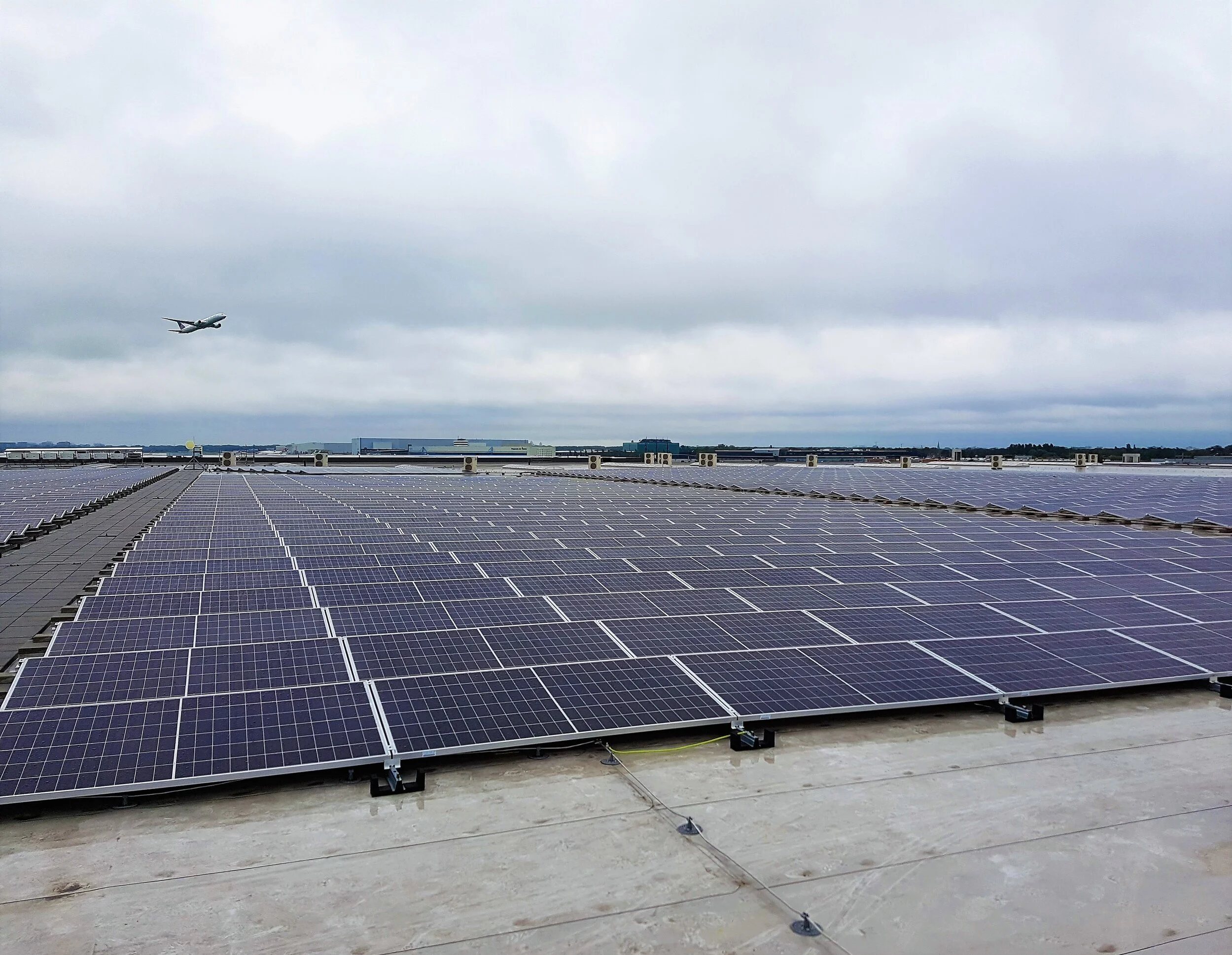
Infraland, working as the Employer’s Agent, has successfully delivered a 2.6 MW rooftop solar project (enough to power over 840 homes annually) across two building roofs at Green Mountains Logistics Park, adjacent to Amsterdam Airport Schiphol. Infraland has been involved from project inception providing financial modelling, tendering of the EPC contract through to commissioning sign off of the installation. The project is accredited to the Netherlands SDE+ subsidy system and a PPA will be completed for the sale of power to the grid. One of the key difficulties was navigating the regulations for developing solar arrays in the Schiphol Airport protection zone. Following the success of this project we are rolling out further rooftop solar investments on another two buildings on the site. Pivotal to the project’s success was the co-ordination of a multi-disciplinary team made up of Savills NL, Cushman & Wakefield, Ikaros Solar, NWT Energy and Loyens and Loeff, working on behalf of fund manager AEW.

Infraland Expands with New Cambridge Office
Infraland Expands with New Cambridge Office
As a result of growing demand for Infraland’s services, the company has opened up a second office at 35 Regent Street in Cambridge. The office will house the firm’s expanding team, becoming a centre of excellence for GIS based site search and acquisition operations. Henry Brown, Managing Director at Infraland commented “Opening a new office in Cambridge, with its world class status as a global tech hub, allows Infraland to tap into a highly skilled and innovative workforce which fits with the firm’s desire to be a best in class site search and development company, in the infrastructure and energy sector. 35 Regent Street is in a fantastic central location allowing us to attract talent and create a vibrant working atmosphere”. The company’s registered office will remain in London with the Cambridge office becoming a centre for day to day operations.
Transmission System Failure – A Catalyst for Investment?
National Grid’s power failure on Friday 9th August at 5pm led to over 900,000 customers being disconnected for around 90 minutes. This power outage appears to be symptomatic of the changes that have occurred to the UK’s energy mix over recent years creating resilience issues. It needs to adapt quickly through investment in network upgrades alongside policy measures to ensure investment in the type of new clean generation, flexibility and storage assets the country needs.
National Grid’s power failure on Friday 9th August led to over 900,000 customers being disconnected for around 15 minutes. The failure caused widespread disruption from London, to Ipswich and up to the North East, with severe train delays and power cuts to critical infrastructure, such as Newcastle Airport and Ipswich Hospital. An investigation has been hastily launched by OFGEM into the causes of the failure, the likes of which last occurred in 2006 (source Limejump), but without the same level of disruption.
National Grid has blamed the failure on a very rare occurrence, where two large scale generators connected to its network came offline within two minutes of each other. Interestingly these weren’t two renewable generators, often blamed for their intermittency, but a mixture of conventional and renewable. The generators involved were the 740 MWe combined cycle gas turbine at Little Barford in Bedfordshire, operated by RWE, and Orsted’s 1.2 GW Hornsea 1 wind farm. According to Lord Adonis, together they accounted for approximately 5% of generation on National Grid at the time of failure.
The circumstances raises interesting questions for the UK’s policy on flexible power and the role of energy storage, as well as National Grid’s part in incentivising these assets. The rapid failure of the two assets resulted in a frequency drop on the network, with automatic failsafe systems shutting down some areas to preserve others. The situation was exacerbated by the large proportion of wind generation in the mix creating a lack of inertia (source Limejump).
The first question is whether the presence of an increased number of flexible generation and battery storage assets, within National Grid’s network could have prevented the issue. Had either of the specific generators been able to rely on a dedicated battery storage unit, which could have reacted within seconds, the level of generation could have possibly been maintained for an interim period, allowing National Grid to call on other flexible generation assets. The second is whether the use of standalone battery storage assets in the right locations could have reacted to control the frequency changes within the network and prevent the issue.
The outcome of the review by OFGEM will be telling. Whilst the private sector has reacted positively over the last four years to deliver both battery storage and flexible peak power generation projects, policy from both National Grid and central government has created a rather ‘stop-start’ market. Examples include the uncertainty of pricing in the frequency response auctions (FFR and EFR) and work to blend the two contracts by National Grid, through to changes in the rules relating to de-rating of batteries in the Capacity Market auctions, and then the temporary and indefinite withdrawal of payments by the government. Admittedly the latter has been out of their control given the EU’s ruling in relation to State Aid rules. Policy has also lacked a geographical focus to pinpoint new assets to point within the network that need them most. Recently DNO’s have sought to change this, but on a relatively small scale.
These issues have stalled a significant number of projects which have found it difficult to attract the debt funding required to move forward and allow them to contribute to the new flexible and resilient network the country needs.
It is also of note that a significant amount of new generation projects constructed in the last 15 years have been connected to the distribution network. This is in contravention to how the national transmission network was originally designed and has resulted in National Grid having to balance and account for reverse power flows. The ongoing closure of large coal fired power stations has also created further in-balance. This trend is illustrated by BEIS statistics below:

Source: BEIS UK ENERGY IN BRIEF 2019
This power outage appears to be symptomatic of the changes that have occurred to the UK’s energy mix over recent years. The energy industry requires coherent and stable policy measures to ensure investment in the type of new clean generation, flexibility and storage assets the country needs. Perhaps this incident will kick start these changes creating a stable environment for new infrastructure investment.